Is Long Covid the Same as MECFS?
Jun 02, 2026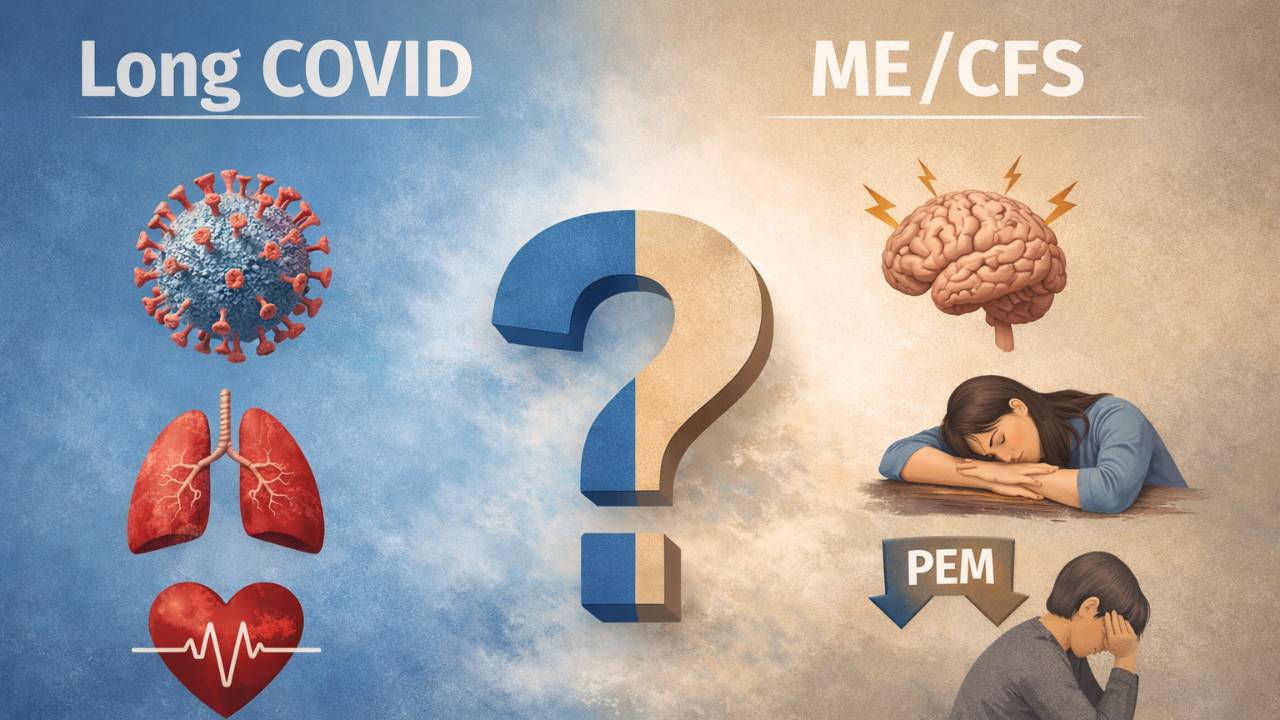
Ever since 2020, there’s been a bit of a pink elephant sitting in the corner of the ME/CFS community. (heyyy who got you picturing a pink elephant? This gal. And now, with tap shoes! Ok, ok I'm stopping.)
And at the same time, there’s been a massive spotlight on that elephant in the world of medical research. Yet for many people, it’s still a point of confusion.
So today, I want to bring it into the center of the room and actually talk about it.
Let’s. Talk. COVID.
For years now, I have gotten messages asking me why I don’t talk about or include long COVID in my video content when naming the mechanics of ME/CFS.
I also get a ton of comments or DMs in which people will say, “What you are describing sounds exactly like my experience with Long COVID.”
There is absolutely overlap between these conditions, but like all things with ME/CFS, there is also nuance, and so I want to make sure that when I speak to this issue, I am as on point as I can be.
The question on everyone's lips is: Is Long COVID the same illness as ME/CFS?
In order to answer this, the first thing to understand is that long COVID is not one single condition. It’s an umbrella term used to include people with organ damage, lung issues, heart complications, loss of taste or smell, and a wide range of other symptoms that do not meet the criteria for ME/CFS.
Many of these people have Long COVID but not ME/CFS. So when we speak to Long COVID, we are speaking to multiple presentations, not a singularly defined illness.
ME/CFS, on the other hand, is a defined illness pattern. The hallmark feature is post-exertional malaise, which is a worsening of symptoms after exertion. This feature sets it apart from all other illnesses.
So where the overlap between Long COVID and ME/CFS comes into play is this:
Some people with Long COVID go on to meet the criteria for ME/CFS. These are the people who end up in my program; those who present with at least six months of severe, unexplained fatigue, post-exertional malaise (PEM), unrefreshing sleep, and cognitive difficulties or orthostatic intolerance and dysautonomia.
Once ME/CFS has been diagnosed, we are no longer just talking about Long COVID as a general term with many different presentations. We are talking about ME/CFS itself, triggered by a viral infection.
A viral-induced trigger for ME/CFS is nothing new. The disease has been triggered by viruses for a very, very long time. We know that Epstein-Barr, Ross River Virus, Coxsackie B, HHV-6, or even pathogens like Giardia or Q Fever can trigger it.
Outside of viruses themselves, sometimes physical traumas, surgeries, or prolonged emotional or psychological stress can trigger it. There are many different entry points into this illness, and (to me), COVID is simply the new and visible trigger associated with ME/CFS.
So COVID, while it’s very visible right now, is one of many possible triggers for ME/CFS. And the reason I am harping on this is because it is the reason why I don't use the term Long COVID broadly in my work. If I were going to speak about long COVID in the context of ME/CFS, I would also have to speak about every other trigger as well.
Ultimately, what I am speaking to is the illness pattern of ME/CFS — not the final trigger that caused it to express.
Now I also want to be really clear about something else, because this is where people get tripped up. A lot of people will write to me and say that the research shows long COVID is fundamentally different... that it causes permanent damage, or that the virus stays in the body in a way that makes it irreversible.
And I understand why they're saying it. Because there is research looking at things like microclots, cytokine blasts, immune system changes, and even the possibility of viral persistence.
But what’s important to understand is this:
These findings do not automatically mean permanent or irreversible damage. And many of these same patterns, immune dysregulation, autonomic dysfunction, and even viral reactivation — have been observed in ME/CFS for decades.
So in many cases, what we are looking at is not necessarily something entirely new, but something we have already seen… now being studied more closely. (I'm not saying COVID isn't new - i'm saying those who present and how they present with MECFS via COVID isn't new).
Where things may actually differ is here:
There is a subset of people with long COVID who have clear structural organ damage — things like myocarditis, lung scarring, or other measurable pathology. And that group is different.
But that is not the majority of long COVID cases. Even more importantly, that group typically does not present with the ME/CFS pattern.
So what we’re really looking at are two groups: One group where there is structural damage. And another group where the illness presents as ME/CFS — with post-exertional malaise, nervous system dysregulation, and energy impairment.
And that second group is where the overlap lives.
My main point this boils down to this:
When long COVID presents as ME/CFS — especially with things like post-exertional malaise — we treat it as ME/CFS. Because at that point, we are working with the same underlying illness pattern, regardless of what triggered it.
A large portion of the people who are now enrolled in my program had their ME/CFS triggered by COVID, and there has been no measurable difference in how they progress or recover versus others who have triggered ME/CFS in some other way.
And this part is super important to me.
Because I see people all the time who clearly meet the criteria for ME/CFS, but they identify only as having long COVID. And then they convince themselves that recovery doesn’t apply to them, but it is my belief that in MECFS, the roadmap is universal, even if the individual journey varies.
The simplest way to understand this is: not all long COVID is ME/CFS, but some Long COVID, like any post-viral syndrome, becomes ME/CFS. And that’s where the overlap lives.
That is why I don’t speak to it on its own in my content, and why I do not call my program the ME/CFS/LC recovery program.
If this resonates, it really doesn't matter what label you decide to use. What matters is understanding the physiological pattern your body is dealing with, and the tools to affect that pattern, because that’s what determines what actually helps you break out of that pattern, and get well.
If you're in need of guidance, support, have questions or are curious about recovery, and want to learn more about The Edison Effect MECFS Recovery Program, you can access my 9 free webinars by clicking the link below!
Let's Connect!
Receive notification for open enrollment periods for The Edison Effect, as well as carefully curated guidance, insights of living/loving & healing from Anj by joining her newsletter.
We hate SPAM. We will never sell your information, for any reason.