Is MECFS A degenerative disease?
Mar 04, 2026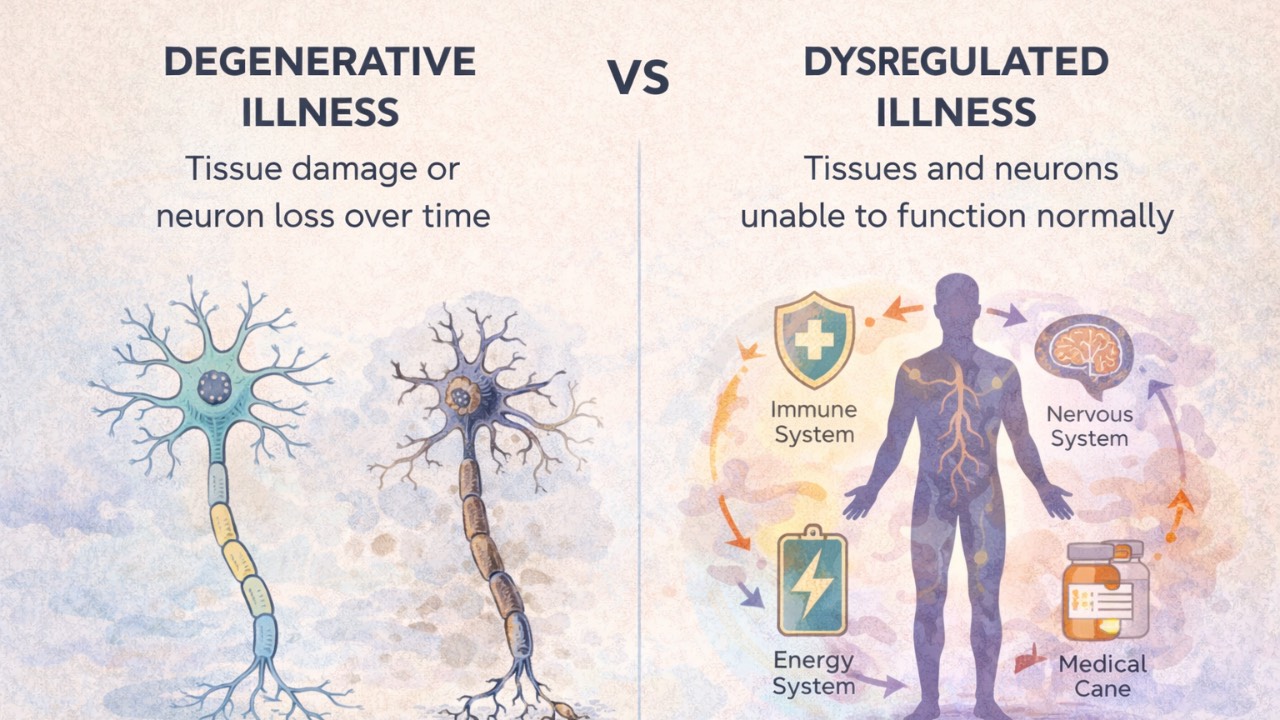
It read: In my last coaching cohort, I received a question that felt important enough to warrant its own newsletter.
“How did you maintain belief in the recovery path you now teach, despite setbacks — especially when conventional medicine frames ME/CFS as irreversible damage rather than primary nervous system dysregulation?”
What a great question! Gold-star for that "Eddie" (as we call ourselves.)
His question sparked another one inside me:
Why did this person believe conventional medicine frames ME/CFS as irreversible damage?
(Because, actually it doesn’t.)
When I was sick, I heard about irreversible damage and MECFS from mostly "support groups" on FB. I wasn't hearing any MECFS research scientists talking about degeneration - so I decided to dig a bit deeper.
And as I did, it became clear that indeed this narrative doesn’t actually come from modern medicine as a whole.
It often comes from within our own community — from people who have worsened, and whose stories then get repeated until they harden into “gospel truth.”
For someone who is already very ill, this framing can be devastating, terrifying and even dangerous - because it can be so hard to hear - that someone already quite fragile might contemplate taking their own life.
And some do.
I know for me personally, this skewed information almost brought me to the brink of no return.
Language that framed MECFS as degenerative and progressive in its nature not only shapes our expectations around recovery, it heightens our terror, which makes our crashes worse and baseline lower.
The fear directly impacts the nervous system, increasing hypervigilance and HPA-axis activation in a body that’s already dysregulated.
So back to the original question that came from this client in my coaching cohort:
How did I maintain belief in recovery tools that seemed to fly in the face of this narrative?
The answer was twofold.
1. I didn’t have blind faith in doctors
Long before ME/CFS, I’d already learned that doctors are not these omniscient gods with all knowing power. They are mere humans working within the limits of their own training, available research, and lived experience. That's it.
Before ME/CFS, I had already reversed multiple conditions doctors told me I’d need medication for — PCOS, hypertension, high cholesterol, fatty liver, cystic acne, depression, anxiety.
I had also been a caregiver to a partner with a severe traumatic brain injury. When he got injured, I was told that he would never wake up, and if he did, would never improve. I was encouraged to take him off life support.
I chose to keep him alive, and through relentless neuroscience-based work, he recovered to about 85% capacity.
That forever changed my view of modern medicine; not because of their care or concern over what his quality of life might be; but because of the authority by which they spoke on an outcome that never happened.
Finally, it should be added that for three years, while I had mild ME/CFS, I was gaslit repeatedy — told to exercise, told nothing was wrong, and told that my symptoms were “in my head.”
In none of these situations did a doctor say, “I don’t know.”
That was all I needed to hear - but instead, they spoke definitively about something they knew nothing about - and showed very little curiosity about my lived experience.
So quite honestly, by the time I reached severe ME/CFS, my trust in them as authority had already cracked.
2. The science didn’t support the degenerative narrative
Despite my skepticism, I still sought care — including treatment at the Neuro Immune Institute founded by Dr. Nancy Klimas. And I received some biological support there, yes. (which would be under Pillar 3 in my program).
But more importantly, I received an education in just a few visit. One that I will be forever grateful for, and which caused me to continue that education on my own for free.
The deeper I researched ME/CFS — and lived inside it — the clearer it became, that the idea that ME/CFS is a progressively degenerating disease is not supported by the science.
Much of the fear it turns out, comes from confusing degeneration with dysregulation.
Degenerative diseases involve permanent structural damage and irreversible loss. Once function is gone, it doesn’t return. Examples of this would be ALS, Parkison's Disease, Alzheimers etc.
ME/CFS does not behave this way.
What research consistently shows instead is persistent dysregulation across systems:
-
abnormal immune signaling
-
autonomic dysfunction (POTS, orthostatic intolerance)
-
impaired energy production (not destroyed mitochondria)
-
stress-response abnormalities
-
altered — but not destroyed — brain signaling
This model explains what so many of us recognize firsthand:
Symptoms often fluctuate.
Crashes are often followed by a boom in which we feel better and sometimes can do more.
There are remissions and relapses and full recoveries.
And most importantly, people respond to pacing, autonomic support, immune modulation, and nervous-system work.
Systems can come back into balance; symptoms can resolve, and life can become normal again.
If ME/CFS were degenerative, this degree of reversibility wouldn’t exist.
Many researchers including Dr. Klimas now describe ME/CFS as a stuck systems condition — reinforcing loops, not permanent damage. This means that if we change the regulatory environment, the biology can shift.
So my friend, please hear me when I say, that I understand the seriousness of MECFS. And nothing I'm sharing today is intended to minimize the seriousness of ME/CFS. It's real. It can be severe, and is always life-altering, even in its most mildest form.
My only point today is that seriousness does not equal irreversibility.
So how did I manage to believe in recovery? By realizing that the science supported what people were reporting in their recovery stories.
And by shifting away from the idea that my body was broken, towards - my body is trying to find balance, but the system is stuck.
I knew that a body dysregulated could learn how to regulate again. So I focused on regulating, stabilizing, expanding and slowly rebuilding my capacity.
I didn't need blind optimism. Or to just "believe." Learning about the physiology of MECFS became my most powerful regulation tool. And that is why I include a thorough understanding of the science of MECFS in my program, The Edison Effect.
Because in this case, having the knowledge about the illness, made all the difference.
If you're in need of guidance, support, have questions or are curious about recovery, and want to learn more about The Edison Effect MECFS Recovery Program, you can access my 9 free webinars by clicking the link below!
Let's Connect!
Receive notification for open enrollment periods for The Edison Effect, as well as carefully curated guidance, insights of living/loving & healing from Anj by joining her newsletter.
We hate SPAM. We will never sell your information, for any reason.