you didn't lose your worth, you lost capacity
Jul 08, 2026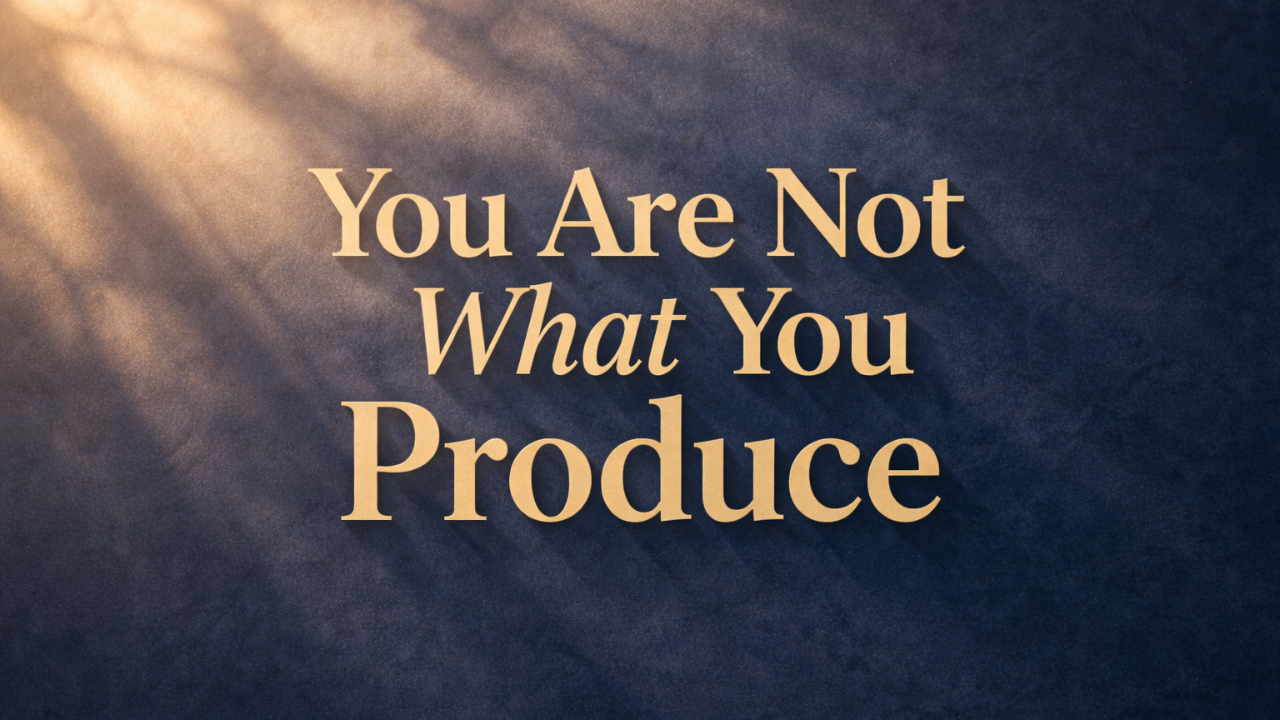
I'm not sure if there was ever an easy time in history to be a sick person. I'm sure in every age there were unique challenges to contend with, but one of the biggest issues of the modern age for the chronically ill, is that we live in a culture where productivity is directly connected to one's inherent value. As a result, the sick are cast aside, mainly because they’re not able to contribute in the ways society values.
Everywhere you look, there are examples of so-called "successful people" on TV or in media who seem to be doing more harm than good. Yet the underlying, unspoken message being fed to us 24/7 is this:
Your worth is determined by output—how much money you can make, how high achieving you can be, how much you can produce. The more you produce, and the more effective you are in producing it, the more elevated your status will be in the eyes of society.
For a person with ME/CFS, this message is not just isolating, but toxic. There is no space for overdoing, pushing, pleasing, or overriding the body's signals in ME/CFS. It's not a lack of desire to achieve, participate, or contribute—it's an inability to. And yet our communities don't see it that way, do they? All they see in us are lazy, unmotivated victims who aren't trying hard enough to get better.
Where does this attitude of productivity = success even come from?
It turns out a lot of this stems back to the Industrial Revolution, where we moved from being paid for a day of work (sun up to sun down, which varied by season and climate) to being paid by the hour (with the invention of the lightbulb making it “daytime” anytime). Then in the tech boom of the late 20th century, there was a not-so-subtle shift toward valuing people based on how mechanically they could live.
Now it is not subtle—it’s covert and deeply ingrained in the post-modern world. The more you can live like a machine—the less rest you take, the more you override your biology—the more valued you are. We are utterly, completely, manically obsessed with movement. And the sinister truth at play is that it is all by design. We are cogs in a wheel—and the wheel master wants it that way.
Because if everything becomes about output and production, it is not only easier to treat people in a less humane way, but it also makes people more disposable.
Enter the chronically ill person—more specifically, a person with ME/CFS—where there is a direct relationship between doing and payback. Sometimes I wonder if the reason there isn’t more research, more care, more urgency around ME/CFS despite how common it is, is because on some level the inability to be productive makes even doctors take it less seriously. I mean, how else did we end up with something like the Millions Missing campaign, where people quite literally disappear from their lives and from the world—and send in their shoes to a giant field so the world will take notice?
And yet still, no one goes looking for these people???
Why? Because everybody is stuck on a hamster wheel of production. And we, the people with ME/CFS, stepped off. Our biology—the organic truth and wisdom of our nature—has taken over.
And yet maybe—just maybe—an answer in recovery lies in this wisdom. As it was for me.
Maybe it was never about getting back on the hamster wheel.
Maybe it was never about blindly being part of the assembly line, deriving our value from producing and achieving and running nonstop until we are ragged and old and dead.
Maybe ME/CFS, in its absolute demand for stillness, can show us a better way.
Maybe by learning this way, on the other side of getting well, we can show those without ME/CFS a better way too.
Learning how to pace as an act of absolute rebellion. A way of returning to the rhythm of the cosmos, in which all organisms except humans pace every day.
For myself, and all of those I work with who are in recovery, so much of the process is about returning to the natural rhythm and order of the body. And yet while we’re doing that work, we’re doing it in direct opposition to what the world is constantly feeding us—through every screen, every marketing message, every form of advertising.
The message is this:
You are worth nothing more than what you can produce.
And well, my friend, I’m here to say—in no uncertain terms—that’s a whole lot of bullshit.
I can easily recall my own dark night of the soul, lying in bed, coming face to face with the reality that I was no longer a world traveler. I wasn’t a musician, a singer, a performer on stage seven nights a week. I didn’t feel like I could be a friend, a sister, or a daughter.
I couldn’t read books.
I couldn’t write poetry.
I couldn’t do.
So I asked myself—what am I? Am I anything at all? Or am I just a body lying in a bed? And what startled me most in that moment was not the illness itself—it was how I arrived at the conclusion that I was no longer a person because I couldn't do anything. That my personhood was tied only to doing.
Alone in that dark room, with no one coming to save me, I had to meet who I was underneath all of it. I had to realize that there was value in simply being alive. In being me. That there was something eternal about me—something uniquely precious that was not dependent on what I could do. It just was. And it helped me find my way out.
So my friend, please know—even with ME/CFS—you are enough.
You are precious exactly as you are—whether you can run five miles or whether you can’t roll over in bed. And everything society has ever told us—everything we’ve been chasing, all of the achieving and pushing and doing, has always been a kind of smokescreen. Something designed so we won’t stop chasing acceptance, so we will keep the wheel in motion.
Because if you truly knew that you had value just as you are, you wouldn’t spend your life trying to earn it. I know that when you have ME/CFS, when the world has left you behind, when you feel missing from your own life, when you feel like you have no value, it can be hard to accept that anyone still sees you.
But I see you.
I believe in you.
And I'm rooting for you.
If you're in need of guidance, support, have questions or are curious about recovery, and want to learn more about The Edison Effect MECFS Recovery Program, you can access my 9 free webinars by clicking the link below!
Let's Connect!
Receive notification for open enrollment periods for The Edison Effect, as well as carefully curated guidance, insights of living/loving & healing from Anj by joining her newsletter.
We hate SPAM. We will never sell your information, for any reason.